For most of our visitors, the mummy is the star of our show, and we do well to start with it.
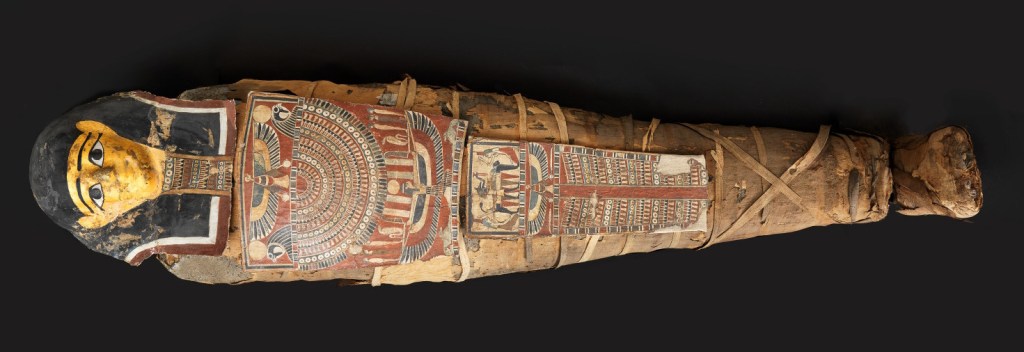
You might be asking: what is an ancient Egyptian mummy doing in Jerusalem? And you would be right. This ancient Egyptian mummy was not found locally, but was given by the Jesuit Fathers in Alexandria (Egypt) to the branch of the Pontifical Biblical Institute in Jerusalem that had just been set up. Two sheets from Egyptian newspapers, dating to 1927 and 1928, were found crumpled up during recent restoration work on the mummy and coffin, corroborating this story.
Who is the deceased? When did he live?
There’s always a name and a story behind every mummy. We know little about the deceased, but recent CT scans have shown him to be some 30-40 years old, relatively old for the period considering the life expectancy. The scans also showed evidence for severe osteoporosis and atherosclerosis, as well as dental caries and receding gums, which suggest that he lived a rather comfortable life, with a rich diet and without much exertion. The mummy is now 154cm long, but would have been 13cms longer (167cm) in life, owing to shrinkage.
The inscription shows he was a minor official. His name reads it.t.Hr-r-w or Yarat‑Hor‑ru, which means, The Protective Eye of Horus.
By the standards of ancient Egypt, this is not a very old mummy (carbon dated to c. 180 BC), dating only to the Ptolemaic period when Egypt fell under the sway of Alexander the Great, and his generals who then carved up his Empire between them. But that still makes it more than 2000 years old!
Embalming the dead
The CT scans also showed that our mummy was embalmed in a traditional way. The brain was removed through the nostrils and internal organs too were removed. Various preservatives too were found: resin inside the skull, and bitumen on the bandages (sourced from around the Dead Sea).
The traditional process of embalming the dead in ancient Egypt was a complex one. The brain and internal organs were removed by an incision to the left of the body, and dried. Lungs, liver, intestines, stomach were placed in canopic jars, while the heart was put back inside the body. The inside of the body was then rinsed with wine and spices. The body was then dried by being covered in natron (salt) for 70 days. Forty days into the process, the body cavity was stuffed with linen or sand to give it a more human shape. At the end of the 70 days, the body was wrapped in bandages from head to toes.
An afterlife for everyone?
In Old Kingdom Egypt (2686–2181 BC), afterlife was a very exclusive business, and reserved only for the King. This is the time of the great pyramids, in Giza (near Cairo) and elsewhere. Slowly access to the afterlife spread through the nobility to the rest of society, such that by the Ptolemaic times of our mummy, even minor officials were mummified, and complex rituals eased their entry into the afterlife.
 Pontifical Biblical Institute in Jerusalem